“Didn’t we already fix that?”
“Why is this harder than it should be?”
You’re losing predictable performance, and probably profit as well.
Predictable Performance
& Profitability
Growth doesn't break your business.
It exposes where performance stops holding under growth.
What's happening
- Work is getting done—but not finishing cleanly
- Decisions keep coming back to you
- Execution varies across the business
- Margins feel tighter than they should
Nothing is stuck.
But nothing is holding.
The business keeps moving.
It just takes more effort than it should.
What this work does
Predictable performance comes back when work, decisions, and money move together instead of pulling apart. Fixing it starts with the two or three changes that will matter most, not a full overhaul.
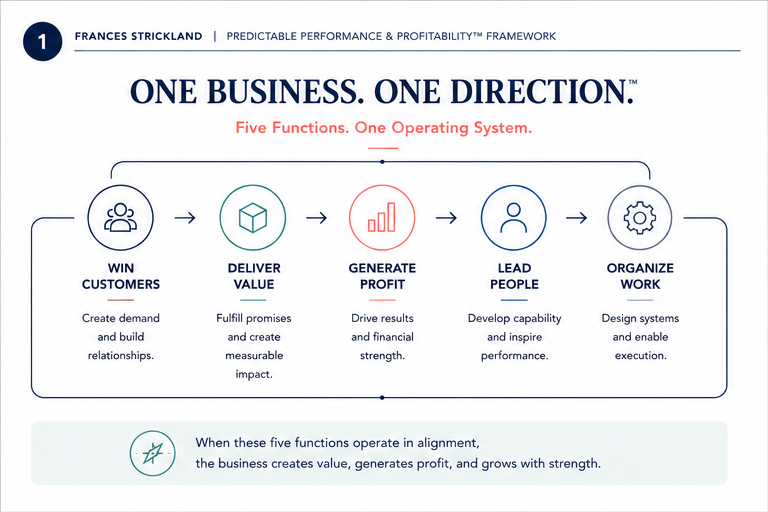
The strain usually shows up in one of these five first, and that is where the diagnostic work begins. Using a structured approach, the business changes how it handles its work, so execution steadies, margins improve, and results become predictable under growth.
How it works
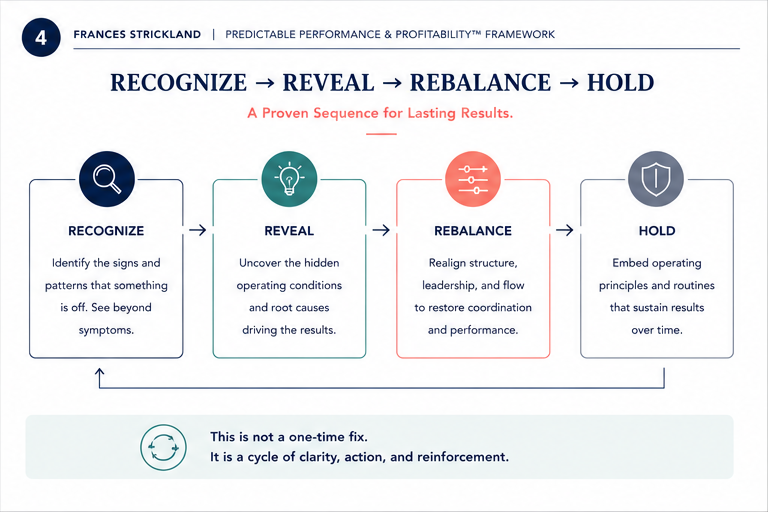
A four-phase sequence. Not a one-time fix, a cycle of clarity, action, and reinforcement.
Why it keeps happening
The problems show up in what the business does day to day: winning customers, delivering value, making profit, leading people, organizing work. The real cause is usually somewhere else. Finding it means looking at who actually decides what and whether that's written down anywhere, who is accountable for the direction the business is taking, and how information and work move once a decision is made. That's where the diagnostic work happens, underneath the part of the business you can already see.
Where this shows up
- Growth is introducing friction
- Leadership roles exist, but decisions still escalate
- Execution varies across teams
- The business depends on you to keep things moving
Where to start
Most engagements begin with Profit Pulse—a focused diagnostic that shows where your business is compensating, and where performance will stop holding under growth.
Take the Profit Pulse No cash · No credit card · No obligationQuestions owners ask
Why do the same problems keep coming back, even after we think we've fixed them?
Usually because the fix addressed the symptom, not the cause. The real cause is almost always somewhere else, in how the business is structured, how leadership decisions get made, or how work actually flows. Until that's found, the same problem keeps resurfacing in a new form.
Why does everything feel harder than it should be, even though the business is doing fine on paper?
Nothing is stuck, but nothing is holding. The business keeps moving, it just takes more effort than it should. That gap between effort and outcome is usually the first sign that performance has stopped being predictable.
How is this different from Profit Pulse?
Profit Pulse is where most engagements start, a free diagnostic that shows where the business is compensating. This work is the next step: using a structured approach to fix what the diagnostic finds, so execution steadies, margins improve, and results become predictable under growth.
Why start with a full business diagnostic instead of just fixing the department that's struggling?
Because the problem is often not where it shows up. A sales problem can actually be a pricing problem. A leadership problem can actually be about who has the authority to decide. Fix one part without seeing the whole business first, and one symptom might look better while the real cause keeps working underneath. Looking at the whole business first means the right thing gets fixed, not just the loudest one.
I've got a handful of problems right now. Should I fix the biggest one, or step back and look at everything?
It depends on whether you know the real problem, or just where it shows up. Most owners can say what's going wrong. Few can say why. Predictable Performance & Profitability starts by looking at the whole business first, not one problem, so what gets fixed is the actual cause, not just the loudest symptom.
I can't fix everything at once. What if I pick the wrong thing to work on?
That's the real risk of guessing. Predictable Performance & Profitability starts with a full picture of the business, so you're not choosing blind. You end up working on the two or three things that will actually change the outcome, not whatever happened to feel urgent this week.
What do you mean by "align my business"?
It means work, decisions, and money all moving the same direction instead of pulling against each other. Right now, one team might be solving problems its own way while another team solves the same kind of problem differently. Aligning the business means everyone is working from the same picture of what's true and what matters, so improvements in one place actually strengthen the whole business instead of just that one team.
How long does an engagement like this take?
Most engagements run 90 days to 12 months, depending on what's found and how much needs to change.
What actually changes when this work is done?
Work, decisions, and money start moving together instead of pulling apart. Execution steadies, margins improve, and results become predictable under growth, without depending on one person to keep everything moving.
If this is already happening, the cost is already building.
And it rarely corrects itself.
Start by seeing where your business is compensating—and where it won't hold.